Rootstocks and tree shapes
The label says ‘Cox’. The small print says M26. The small print decides whether you get a patio tree or something to hang a swing from.
What a rootstock does
Apple trees are sold as two plants joined together: a rootstock, which controls the tree’s size, and a cultivar, which forms the top. RHS: Stepover training
From tiny to huge
| Rootstock | Vigour | Tree height | Starts fruiting | Source |
|---|---|---|---|---|
| M27 | extremely dwarfing | 1.2–1.8m | after two years | RHS: Fruit tree rootstocks |
| M9 | dwarfing | 1.8–2.4m | after two or three years | RHS: Fruit tree rootstocks |
| M26 | dwarfing | 2.4–3m | after two or three years | RHS: Fruit tree rootstocks |
| MM106 | semi-dwarfing | 3–4m | after three or four years | RHS: Fruit tree rootstocks |
| MM111 | vigorous | 4–4.5m | after four or five years | RHS: Fruit tree rootstocks |
| M25 | very vigorous | over 4.5m | after five or six years | RHS: Fruit tree rootstocks |
MM106 is semi-dwarfing: it starts fruiting after three or four years and makes a tree about 3–4m (10–13ft) tall. It’s the most widely used rootstock, but too big for small gardens. RHS: Fruit tree rootstocks
For small gardens, pots and cordons, the RHS suggests a dwarfing rootstock such as M9 or M26. RHS: How to grow apples
Bush, half-standard or standard?
A bush tree has a clear trunk of about 75cm (30in) before the branches start; a half-standard about 1.35m, and a standard about 2m. RHS: Choosing the best fruit trees
Trained shapes for small spaces
Cordons
A cordon is restricted by pruning to one main stem, upright or at 45°, with short fruiting side-shoots called spurs. RHS: How to grow apples
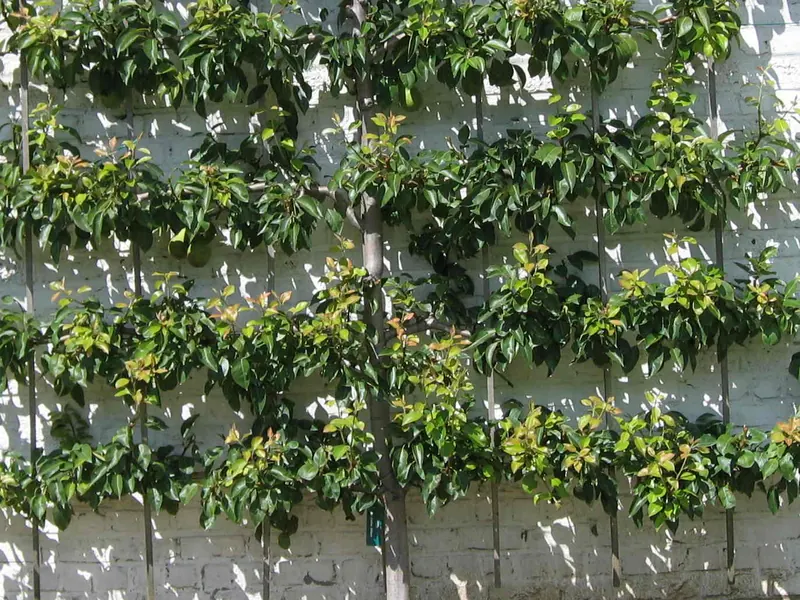
Espaliers
An espalier is trained flat against a wall or fence, with a central stem and tiers of horizontal arms. Most have three or four tiers and reach about 1.8m tall and 3–4.5m wide. RHS: Training an espalier
Established espaliers need pruning every year in late summer, or they slowly turn back into ordinary trees. RHS: Training an espalier
Stepovers
A stepover is a tiny tree with a short trunk, usually 45–60cm tall, and one or two arms trained sideways to make a T-shape, low enough to step over. RHS: Stepover training The two arms of a T-shaped stepover can stretch to 3–3.5m in total. RHS: Stepover training
M27 is the best rootstock for a stepover; M9 is useful for stepovers on poor soil. RHS: Stepover training
Tip-bearing apples, which fruit at the ends of their shoots, aren’t suitable for stepovers. RHS: Stepover training
In a pot
For a pot, choose an M9 or M26 tree and a container at least 45cm (18in) across, filled with John Innes No 3 compost. RHS: How to grow apples
Next: planting and care →